


From Revolutionary Pamphlets to Viral Posts: Punjab’s Youth in India’s Digital Age
- May 26
- 4 min read
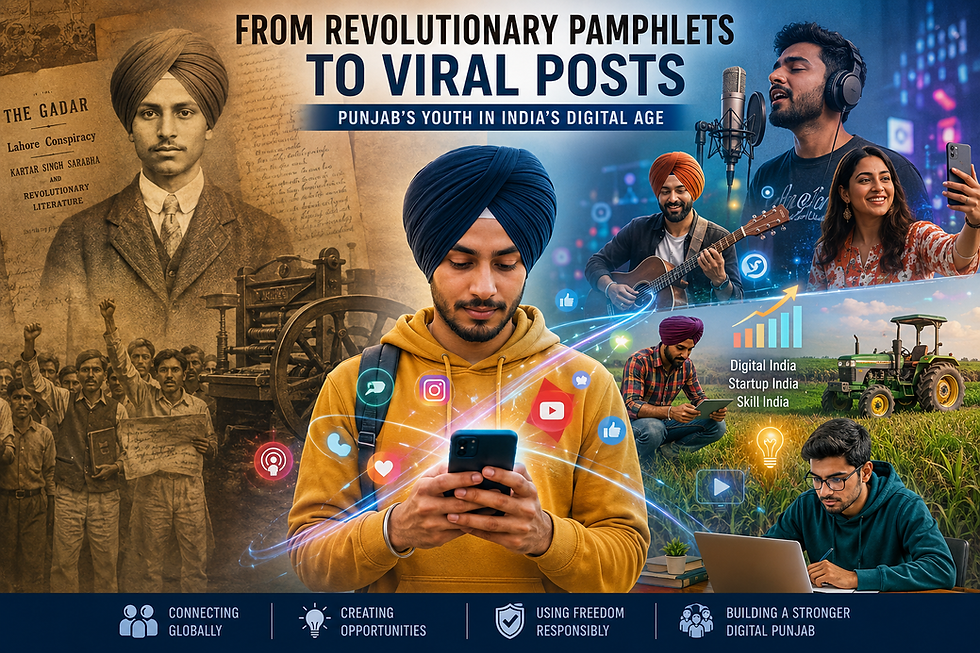
Punjab has always been known for the energy, courage, and determination of its youth. From the freedom struggle led by revolutionaries like Kartar Singh Sarabha to the Green Revolution that transformed India’s agricultural future, the state’s younger generations have consistently shaped national progress. Today, however, the battleground has shifted. Instead of pamphlets and public gatherings, ideas now travel through smartphones, reels, podcasts and social media platforms. The digital era has given Punjab’s youth unprecedented power to communicate, influence and connect with the world. Yet, this new freedom also brings responsibility, especially in a time when misinformation can spread faster than truth.
Punjab today is among India’s most digitally connected states. Young people in cities as well as villages actively consume and create online content. Whether it is music, comedy, educational videos, fitness coaching or entrepreneurship, Punjabi youth have carved a visible presence on digital platforms. India itself is expected to cross nearly 900 million internet users in the coming years, with a significant share being under the age of 35. Affordable smartphones and low-cost data have made digital participation accessible even in rural communities. This transformation has opened opportunities that previous generations could hardly imagine.
The rise of Punjabi creators on YouTube, Instagram and other platforms reflects this new confidence. Many young people are using social media not only for entertainment but also for income generation and skill development. Independent musicians from Punjab now reach international audiences without traditional production houses. Small business owners market products online directly to customers. Students prepare for competitive exams through digital learning platforms. Influencers discuss mental health, career guidance and financial literacy in Punjabi, making information accessible to a broader audience. In many ways, digital media has become a bridge connecting Punjab’s local identity with global opportunities.
Recognizing the importance of technology-driven growth, the Union Government has introduced several initiatives aimed at empowering India’s youth digitally. Programs such as Digital India, Startup India, Skill India and PMGDISHA (Pradhan Mantri Gramin Digital Saksharta Abhiyan) are designed to improve digital literacy, encourage innovation and generate employment opportunities. These schemes have especially helped young Indians from smaller towns and semi-rural areas gain access to online education and entrepreneurial platforms. Punjab’s youth, known for adaptability and ambition, stand among the major beneficiaries of this expanding digital ecosystem.
At the same time, the rapid growth of online influence has created new social challenges. Social media today rewards speed and sensationalism. Viral content often gains attention regardless of whether it is factual or misleading. Many young users consume information without verifying its authenticity, especially when it appears emotionally charged or visually convincing. The emergence of artificial intelligence and deepfake technology has made this problem even more serious. Edited videos, manipulated speeches and fabricated claims can circulate within minutes, creating confusion and unnecessary panic.
Punjab, because of its emotionally connected diaspora and highly active online communities, sometimes becomes particularly vulnerable to misinformation campaigns. Certain digital voices attempt to amplify negativity, spread unverified narratives or create social division for attention and engagement. In such cases, the challenge is not freedom of expression itself but the misuse of digital platforms. Constructive criticism, healthy debate, and public discussion remain important in any democracy. However, deliberately misleading or baseless content can damage social harmony and misguide impressionable audiences, especially the youth.
This is where the role of regulation becomes important. Over the past few years, India has strengthened its Information Technology Rules and digital governance framework to improve accountability among social media intermediaries. The focus of these measures is largely on identifying unlawful, fake, manipulated or harmful content rather than suppressing genuine public discussion. Platforms are increasingly expected to act against misinformation, online fraud and AI-generated deceptive content. Such regulations are not unique to India; governments across the world are struggling to balance digital freedom with online safety and authenticity. Importantly, these policies are aimed at ensuring responsible digital participation rather than limiting creativity or criticism. Content is generally flagged or blocked only when it violates legal standards, spreads falsehoods, incites disruption or promotes harmful misinformation. Genuine creators, educators, artists, and commentators continue to thrive on digital platforms across India. In fact, many government-backed initiatives actively encourage innovation and online entrepreneurship among young people. The larger message is clear: digital platforms should empower society, not mislead it.
For Punjab’s youth, this moment presents both opportunity and responsibility. The state has immense creative potential. Punjabi music dominates streaming charts globally, and the state’s cultural influence extends far beyond India. Young Punjabis are increasingly entering fields such as digital marketing, gaming, app development, content production and e-commerce. Social media has also allowed local talent from villages and small towns to gain national visibility without traditional barriers. This democratization of opportunity is one of the most positive aspects of the digital revolution.
However, the future of this digital ecosystem depends on awareness and critical thinking. Young users must learn to distinguish between authentic information and emotionally manipulative content. A viral post does not automatically become a fact simply because it receives millions of views. Digital literacy today is not only about operating technology but also about understanding the ethics of sharing and consuming information responsibly. Schools, families, educators and influencers all have a role in promoting this awareness.
The positive side of Punjab’s digital youth culture remains far stronger than the negative. Thousands of students use online platforms for learning new skills and preparing for careers. Young farmers are adopting digital tools to access agricultural information and market trends. Artists are preserving Punjabi language and heritage through podcasts, films and online storytelling. Entrepreneurs are creating startups that provide employment and innovation. These developments show that technology, when guided responsibly, can become a powerful instrument of growth.
If earlier generations used newspapers and revolutionary literature to awaken social consciousness, today’s generation possesses an even greater communication tool in the form of social media. The challenge before Punjab’s youth is not whether they should express themselves freely- they absolutely should, but how they can use that freedom constructively. A strong digital society is built not by silencing opinions but by encouraging truthful, informed and responsible voices over misleading ones.
As India advances deeper into the digital era, Punjab’s youth have the potential to become leaders not only in entertainment and influence but also in digital responsibility. Government policies can provide infrastructure and safeguards, but the true strength of the online ecosystem depends on the maturity and awareness of its users. In the end, the smartphone in every young hand is more than a device- it is a platform capable of shaping society itself.


Comments