Beyond the Shadows of 1984: Why Punjab's Future Lies in Progress, Not Separatism
- 2 days ago
- 4 min read

Every year, the anniversary of Operation Blue Star rekindles memories of one of the most painful chapters in Punjab's modern history. For many Sikhs, June 1984 remains deeply emotional, not only because military action took place within the holiest shrine of Sikhism, but also because the events that followed left wounds that affected generations. More than four decades later, however, an important question confronts Punjab: should the memory of 1984 be used to build a stronger future, or should it continue to be exploited to perpetuate division and grievance?
The answer is becoming increasingly clear from the choices ordinary Punjabis are making.
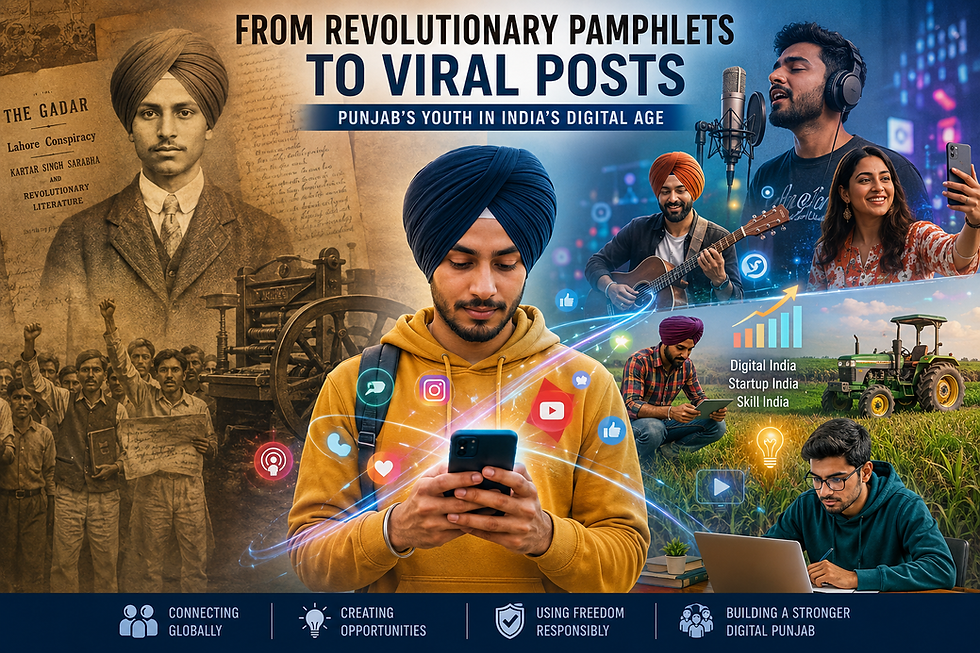
Today's Punjab is remarkably different from the Punjab of the 1980s. Its youth are competing in global markets, building businesses, serving in the armed forces, excelling in sports, pursuing higher education abroad, and embracing technological innovation. The priorities of the average Punjabi household are jobs, education, entrepreneurship, agriculture, and economic opportunity, not separatist politics.
Yet every year around the Blue Star anniversary, familiar attempts emerge to revive narratives that seek to portray Punjab as trapped in an unfinished political struggle. These narratives are amplified by a small but vocal ecosystem of extremist groups, overseas activists, and social media influencers who continue to push separatist agendas under the guise of historical remembrance.
The distinction between remembrance and radicalisation is critical. Remembering history is legitimate. Every society must confront difficult chapters of its past. But exploiting historical trauma to encourage political extremism serves neither Punjab nor Sikhism. In fact, it often undermines both. Recent events provide valuable insight into this reality.
Over the past few years, security agencies have repeatedly uncovered networks linked to extremist and terror-related activities in Punjab. Just days ago, a special NIA court sentenced three individuals to ten years of rigorous imprisonment in a terror conspiracy case linked to a banned outfit after weapons and explosive materials were recovered from a hostel room in Jalandhar. While the case itself concerns specific individuals, the broader lesson is important: attempts to revive militancy continue to surface periodically, despite overwhelming public rejection.
What is equally significant is how society reacts to such incidents. Public response today is vastly different from the atmosphere that existed decades ago. Across social media platforms and public discussions, there is little appetite for a return to violence. Instead, most voices emphasize law, order, development, and stability. This reflects a deeper transformation within Punjab itself. The generation that witnessed the violence of the 1980s and early 1990s understands the human cost of extremism. Thousands of families suffered. Communities experienced fear and uncertainty. Economic growth slowed. Social trust weakened. The scars of that period remain part of Punjab's collective memory.
As a result, many Punjabis today view calls for separatism not as a solution, but as a dangerous distraction from genuine challenges facing the state. Indeed, some of the strongest arguments against separatism come not from governments or security agencies, but from Punjab's own success stories. Consider the achievements of Punjabi youth. Just recently, a farmer's daughter from Rupnagar secured the top rank in a nationwide Indian Air Force examination, earning admiration across the country. Her achievement symbolizes the aspirations of a new generation that seeks opportunity, excellence, and national contribution.
Such stories resonate because they represent real pathways to empowerment. They demonstrate that Punjab's future is being shaped in classrooms, laboratories, startups, farms, universities, and military academies rather than through slogans circulating on social media. The Sikh community's global reputation further reinforces this reality. Whether during natural disasters, humanitarian crises, or public emergencies, Sikh institutions and volunteers are often among the first to provide assistance. The principles of seva, compassion, courage, and community welfare have earned Sikhs admiration worldwide. These values have strengthened the community's standing far more effectively than any separatist campaign ever could.
Ironically, many extremist narratives often overlook these very strengths.
Instead, they attempt to frame Sikh identity through a narrow political lens. Such portrayals fail to reflect the diversity of Sikh experiences and aspirations. The overwhelming majority of Sikhs across India and the world are focused on faith, family, education, business, and community service rather than political confrontation. The digital age has also changed the nature of the debate.
Social media allows emotionally charged content to spread rapidly, particularly among younger audiences who may not have direct memories of Punjab's violent decades. Selective historical narratives, edited videos, and provocative messaging can sometimes create distorted perceptions of complex events. However, the same digital space also enables informed voices, historians, community leaders, and ordinary citizens to challenge misinformation. Increasingly, online discussions reveal a growing preference for balanced historical understanding rather than simplistic narratives of victimhood or conflict.
This shift is important because Punjab today faces challenges that require practical solutions. Issues such as employment generation, agricultural sustainability, industrial growth, drug abuse prevention, education reform, and infrastructure development demand attention and resources. Separatist rhetoric offers little guidance on addressing these concerns.
Punjab's future competitiveness will depend on attracting investment, encouraging innovation, strengthening educational institutions, and creating opportunities for young people. These objectives require social stability, democratic participation, and constructive engagement with broader economic realities.
As another Blue Star anniversary approaches, reflection remains necessary. The pain associated with 1984 should neither be forgotten nor politicized. Historical memory deserves respect. Families affected by those events deserve empathy. Serious discussion about the mistakes and consequences of that period remains important.
But remembrance should ultimately serve reconciliation, understanding, and progress. Punjab's greatest strength has never been anger. It has been resilience. From rebuilding after periods of violence to becoming a global symbol of hard work, courage, and service, Punjabis have repeatedly demonstrated an extraordinary ability to move forward without forgetting their roots.
The true legacy of Punjab is not found in calls for division. It is found in the enduring spirit of Chardi Kala, the determination to rise above adversity while working for the welfare of all.
That spirit remains Punjab's most powerful answer to extremism today. Four decades after 1984, it continues to offer a path not toward separation, but toward confidence, prosperity, and lasting peace.


Comments